
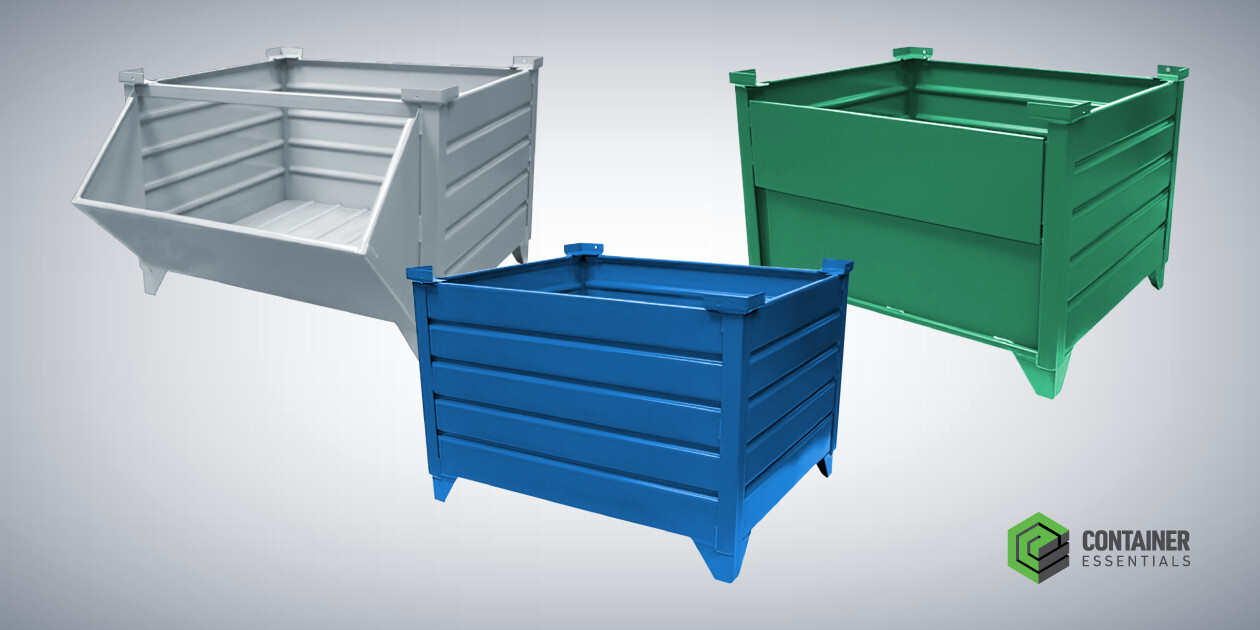
Most buyers shopping for corrugated metal bins have already decided on steel. They know they need a heavy-duty bulk container that can withstand a forklift hit, hold real weight, What they're less sure about is whether they need a standard solid bin, drop gate bin, hopper front bin, and what options are best for their application. Choosing the wrong steel bin can lead to a large investment in containers that don't work well for your application.
The basics: what all three have in common
Corrugated metal bins go by many names. Corrugated steel containers, rigid steel bulk containers, steel storage bins, metal storage bins, metal tote boxes, steel totes. Same product. The ridged corrugated panels add strength compared to smooth-sided bins, which matters when you're loading heavy parts and stacking loaded units five high.
These are true heavy-duty bulk storage containers, built for the materials that chew up lighter packaging. Metal castings, forgings, stampings, fasteners, machined parts, and loose scrap. They store it, they transport it, and they free up floor space while doing both, because you're stacking up instead of out. We offer rigid metal bins for sale in several sizes and three front configurations.
Every bin in the lineup shares these specs:
4,000-pound load capacity. Five-high stacking, fully loaded, carried by heavy steel corner posts and stacking feet, so the bin underneath isn't crushed. 4-way forklift entry from every side. Eleven interior footprints, from 24 by 24 inches up to 48 by 48 inches. Volumes from 6 to 32 cubic feet. 12 to 13 gauge corrugated steel, depending on the model. Made in the USA. Standard colors are blue, green, teal, and black, with raw unpainted steel available.
Where they differ is the front. That's the part worth thinking through.
Standard metal bin
View Standard Metal Bin options →
The standard bin is a solid four-sided industrial storage container, open at the top, with no moving parts. It's the right choice for any material loads from above and comes out by tipping or by forklift. Scrap metal collection, metal stamping waste, castings and forgings, commercial recycling, and general heavy parts storage. These are the bins that just do the job and don't ask for anything in return.
Two things the standard bin offers that the other two don't.
First, it's the only style available in an 18-inch interior height. That matters more than people expect. Dense material like steel scrap gets heavy fast, and a deep bin can hit the 4,000-pound limit before it even looks full. A shorter bin gets loaded and transported before weight becomes the problem. A lot of recyclers and stamping shops run the 18-inch for exactly that reason.
Second, it's the only style that takes lifting lugs, sometimes called hoisting hooks, for crane and hoist handling. If your facility moves bins overhead instead of on the floor, the standard bin is the one to spec.
Choose the standard bin when no one reaches into it by hand, when crane handling is required, or when the lower 18-inch height suits your material better than the taller 24-inch height.
Metal bin with drop gate
View Metal Bin with Drop Gate options →
The drop gate, also called a half drop door, adds a hinged panel to the long side of the bin. It folds down so a worker can access the contents more easily, then latches back into a solid wall. This is especially helpful in applications with larger, heavier parts that are handled manually. On a 24-inch interior bin, the outside wall is 29.5 inches tall. Reaching over that to pull parts out by hand all day can wear people down over a full shift.
The half-drop gate is available on the 24-inch interior height, not the 18-inch, and it sits on the long side by default. The drop gate is useful for front-access manufacturing cells, automotive parts picking, and anywhere people pull material out by hand all day. If manual picking is part of the routine, the drop gate is the answer.
Metal bin with fixed hopper front
View Metal Bin with Fixed Hopper Front options →
The fixed hopper front replaces one side panel with an angled open slope that tilts the contents toward the operator. Buyers also search for it as an open hopper front, and that's exactly what it is. No door, no hinge, no moving parts. Just an open face with a smooth rolled edge that won't catch a sleeve or scratch an arm.
Two jobs it does better than the others.
Constant picking. When someone grabs parts out of a bin again and again through the shift, the slope brings the contents forward and keeps them visible instead of collecting at the bottom. Shorter reach, better sightlines, faster picking. That's why open hopper bins show up at order-picking and assembly-line stations.
Pour out. Tip a hopper front bin and material runs out clean down the slope, with no flat back wall fighting the flow. For operations that dump into a chute, a hopper, or another container, that matters.
One thing to check before ordering. The hopper slope extends past the bin body, which adds several inches to the overall footprint. Measure aisle width and rack spacing before you spec these for a tight layout. Like the drop gate, the hopper front comes on the 24-inch interior height only.
Options that change how you handle the bins
The three front styles decide how material gets in and out. The options decide how you move, store, and identify the bins once they're full. With one exception, any of these can be added to any of the three styles. Here's what each one does and when it earns its place on your order.
Forklift handling
Fork tubes
Enclosed channels welded across the underside, also called fork tunnels or forklift channels. The forks slide inside and stay captured, so the bin can't shift or slide off mid-lift or while you're traveling across the yard. Worth it when bins get moved constantly, or when you want a more secure lift than bare forks under the base. Usually set up for entry from two sides, also a great option for use with forklift rotators.
Fork stirrups
Also called fork straps or fork guides, they are welded onto the bottom of the container where the fork tines enter only, using much less metal than fully enclosed fork tubes. The forks sit inside them but aren't boxed in, so you get less metal and a lower price than fork tubes, and the forks still land where they're supposed to instead of you guessing the angle of approach.
Rack and floor handling
Angle runners
Lengths of steel angle run along the bottom of the bin, also called steel angle runners. They give the bin a continuous rail to sit on, which spreads the load when bins rest on pallet-rack beams or supports instead of stacking on the floor. They also let the bin slide rather than catch on its feet.
Skid bars
Flat steel runners across the bottom, also sold as skid bar runners. Same idea as angle runners, with a flatter profile. They let bins slide across the floor without the feet digging in, protect the underside, and give a stable base on rack or decking. Which one fits usually comes down to your rack or decking type, so tell us how you're storing them and we'll match it.
Crane handling
Lifting lugs
Welded lifting points, also called hoisting hooks, that let a crane or hoist pick the bin up from above with hooks or chains. This is the option for foundries, mills, and any operation that moves material overhead instead of on the floor. Lifting lugs are available on the standard bin only. They are not offered on the drop gate or hopper front styles.
Identification and finishing
Card holders
A 5 by 7 inch holder mounted on the bin to carry routing cards, travelers, or part identification. Keeps the paperwork moving with the load instead of floating around the floor.
Custom stenciling
Painted stenciling for your company name, part numbers, bin numbers, or plant location. The simplest way to keep bins assigned to the right line, department, or supplier instead of wandering off.
Inside leg caps
Caps fitted into the corner legs of the bin that add extra strength right where the legs take the most stress. Worth adding on bins that see rough handling or carry loads near the top of the weight rating.
When you request a quote, tell us how you load, move, store, and empty the bins, and we will help you choose the right options for your application.
How to decide
If the bin gets loaded and moved without anyone reaching in by hand, get the standard. It costs less, comes in both heights, and is the only style that supports crane handling.
If workers pull material out by hand during the shift, and you want them upright instead of leaning over the side, get the drop gate. Controlled access, with a drop door that stays shut the rest of the time.
If bins get picked constantly or the material needs to be poured out clean, get the hopper front. The fixed open slope keeps contents forward and access is effortless.
Then match the options to how you handle them. Fork tubes or stirrups for frequent forklift moves, angle runners or skid bars for rack storage, lifting lugs for overhead handling on standard bins, card holders and stenciling to keep them organized, leg caps for bins that take a beating. Plenty of plants run a mix of all three styles with different options on each. Since they all stack and forklift the same way, mixing doesn't complicate handling.