
Gorilla 4-Way vs. 2-Way Containers: Which Design Is Right for Your Operation?
When you’re deciding between a Gorilla 4-Way and a Gorilla 2-Way container, the choice comes down to how you move material, what your forklift operators need, and whether the upfront cost difference matters more than long-term flexibility.
Both bins are popular in food processing and metal recycling operations. The 2-Way model is a popular choice for paper recycling. Both are nestable, FDA and USDA compliant, with a 2,500 lbs. weight capacity, but there are some major differences.
Here’s what separates them.
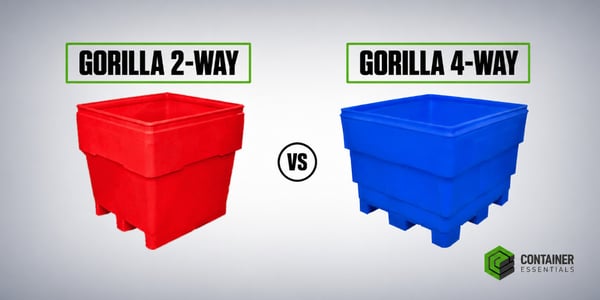
Quick Comparison
| Feature | Gorilla 2-Way | Gorilla 4-Way |
|---|---|---|
| Construction | One-piece molded unit | Two-piece with removable pallet |
| Bottom type | Channel bottom | Flat bottom |
| Forklift access | Two sides only | All four sides |
| Upfront cost | Lower | Higher |
| Pallet replacement | No (one-piece design) | Yes (bolt-on base) |
| Drain installation | Difficult (ribbed channels) | Easy (flat surface) |
| Material collection | Channels can trap debris | Smooth surface |
| Rotator compatibility | No | Yes (with rotator bars option) |
| Best for | Budget-conscious, standard handling | High-throughput, custom applications |
One-Piece vs. Removable Pallet
Gorilla 2-Way: One-Piece Design
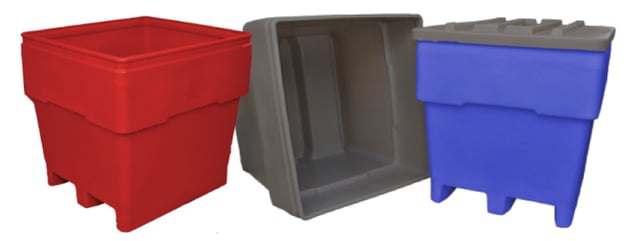
The Gorilla 2-Way is a single molded unit. The bottom and walls are continuous, with no separate base. This makes it simpler to manufacture, which keeps the upfront cost lower than the 4-Way.
There are no bolts to check, no separate components to manage, and no assembly required. For operations that want straightforward bulk containers without extra complexity, this design works.
Gorilla 4-Way: Removable Pallet Base
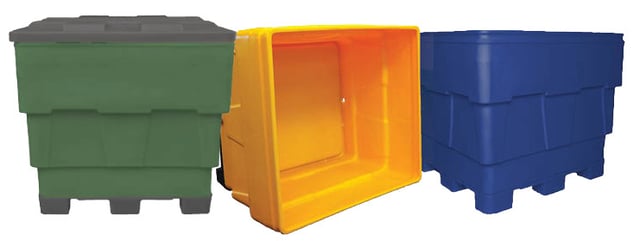
The Gorilla 4-Way uses a bolt-on pallet base that can be removed and replaced independently from the container body.
What this means in practice:
Pallet bases take a beating. Forklift tines repeatedly hit them, heavy loads stress the runners, and eventually cracks appear. With the 4-Way, you swap out the damaged pallet while keeping the same container body. The 2-Way? Once the base is shot, the whole thing is scrap.
For companies running hundreds of these containers in demanding environments, being able to replace just the pallet can add years to the lifespan of their entire fleet. It’s a higher upfront cost, but you’re not buying complete replacements as often.
Channel Bottom vs. Flat Bottom
This is where the two designs behave very differently in daily use.
Gorilla 2-Way: Channel Bottom
The channel bottom has molded ribs running across the base. These ribs add structural strength, but they also create grooves where material can collect.
When it’s not a problem:
If you’re handling dry bulk materials and you completely invert the containers during unloading (using a rotator tipper to dump them upside down), trapped material in the channels isn’t an issue. Everything falls out.
When it is a problem:
If you’re scooping material out by hand, using a vacuum, or handling wet or sticky products, the channels can collect residue. Cleaning can take longer, so in food processing or other applications where sanitation matters, this can add to labor cost.
Gorilla 4-Way: Flat Bottom
The flat bottom has no ribs or channels. The surface is smooth.
This makes it easier to clean and reduces spots where the product can get stuck. It also makes it easier to add a drain. Since Gorilla 2-Way containers have channeled bottoms, drains would need to be installed towards the bottom of all three legs.
Forklift Access: 2-Way vs. 4-Way Entry
Gorilla 2-Way: Two-Side Access
Forklift tines enter from two sides only. The angled leg design on the base deflects tines on entry, which protects the container from forklift damage over time.
For facilities with tightly controlled workflows where containers always get picked up from the same orientation, this works fine. But if your operators need to grab containers from different angles depending on where they’re staged, 2-way entry can slow things down.
Gorilla 4-Way: Four-Side Access
Forklifts can grab these from any side. If a container is sitting sideways or backed into a corner, your operator doesn’t need to reposition it first. They just pick it up and go.
If you have a tightly controlled operation where everything stays in the same spot, 2-way entry is probably fine. But if you’re running a busy loading dock where containers get dropped wherever there’s space, or you’ve got tight aisles where operators can’t always line up the same way, 4-way access saves time.
It’s not a huge difference on one lift. But when you’re moving 200 containers a day, those extra seconds add up.
Rotator Compatibility
The Gorilla 4-Way can be fitted with rotator bars, which allow it to work with rotator tipper attachments on forklifts. This lets you dump the container by rotating it instead of manually scooping out material.
The Gorilla 2-Way is not compatible with rotator attachments due to its one-piece design and channel bottom structure.
If your operation uses or plans to use rotator tippers for faster unloading, the 4-Way is the only option in this product line that supports it.
Cost: Upfront vs. Long-Term
The Gorilla 2-Way costs less to buy. Fewer parts, simpler construction, lower price tag.
The Gorilla 4-Way costs more when you first order it. But here’s where it gets interesting: if you’re beating these containers up daily and running a big fleet, being able to replace just a busted pallet instead of tossing the whole unit starts to matter.
Do the math over five years in a tough environment and the 4-Way might actually cost you less, even though you paid more up front. Or it might not. Depends on how hard you use them and how many you’re running.
Which One Fits Your Operation?
Choose the Gorilla 2-Way if:
- You’re budget-focused and need to minimize upfront cost.
- Your forklift operators always approach from the same sides.
- You’re handling dry bulk materials and inverting containers to unload.
- You don’t need drain customization.
- You’re in paper recycling or similar operations where the channel bottom doesn’t interfere with workflow.
Choose the Gorilla 4-Way if:
- You need forklift access from all sides for faster throughput.
- You want the option to replace just the pallet when the base wears out.
- You need to install drains or prefer a flat bottom for easier cleaning.
- You use or plan to use rotator tipper attachments.
- You’re running a large fleet in food processing, metal recycling, or manufacturing where long-term durability matters.
Frequently Asked Questions
Are both containers nestable?
Yes. Both the Gorilla 2-Way and 4-Way are designed to nest when empty, which saves floor space during storage and return shipments. With the optional lid, both can also stack. Learn more about nestable containers.
Can I add drains to either container?
Yes, but it’s easier on the Gorilla 4-Way due to the flat bottom. The Gorilla 2-Way’s channel bottom makes drain installation more complicated.
What sizes are available?
The Gorilla 2-Way comes in four sizes: 41x41x33, 47x43x36, 47x43x45, and 43x43x51.
The Gorilla 4-Way comes in six sizes: 48x44x36, 48x44x38, 48x44x42, 48x44x45, 48x44x48, and 48x44x56.
Are both food-grade?
Yes. Both are FDA and USDA compliant and made with 100% virgin materials, making them suitable for food processing, pharmaceutical, and other applications where contamination is a concern.
Need help deciding? Contact Container Essentials at (866) 289-9181 or contact us below. We can walk through your specific handling requirements and recommend the best fit.
Contact Us